Citește acest articol în română aici.
Reading time: 5 minutes
Recently, Father I. recommended a text written by Monsignor Luis Maria Martinez. It consists of three meditations titled „How to Receive Jesus Who Comes.” These meditations possess an irresistible depth and warmth that have made me seriously reflect on how I welcome Jesus into my heart.
Monsignor Martinez says that we must be a „complete Bethlehem” to be able to receive Jesus. That is: the humility of the stable, the fidelity of Joseph, and the maternal and tender love of Mary. It seemed to me that he was asking too much. A „complete Bethlehem”?! Couldn’t we just choose? Well, the author says no. We must be „complete.”
Victimization and Free Will
Christmas is approaching, Jesus wants to be born, and He has chosen my heart. How do I prepare it? What would I take out of my heart to make room for Him? Given that until now I have defined myself only through the diagnoses received from doctors, perhaps the first thing I should remove from my heart is victimization. I do not deny my suffering, I do not hide it, but I try to understand it and live with it. We are not perfect; God does not love us because we are perfect, but, as Monsignor Martinez says, He is attracted to our „misery.” Why? Because He can transform our „trash” into gold.
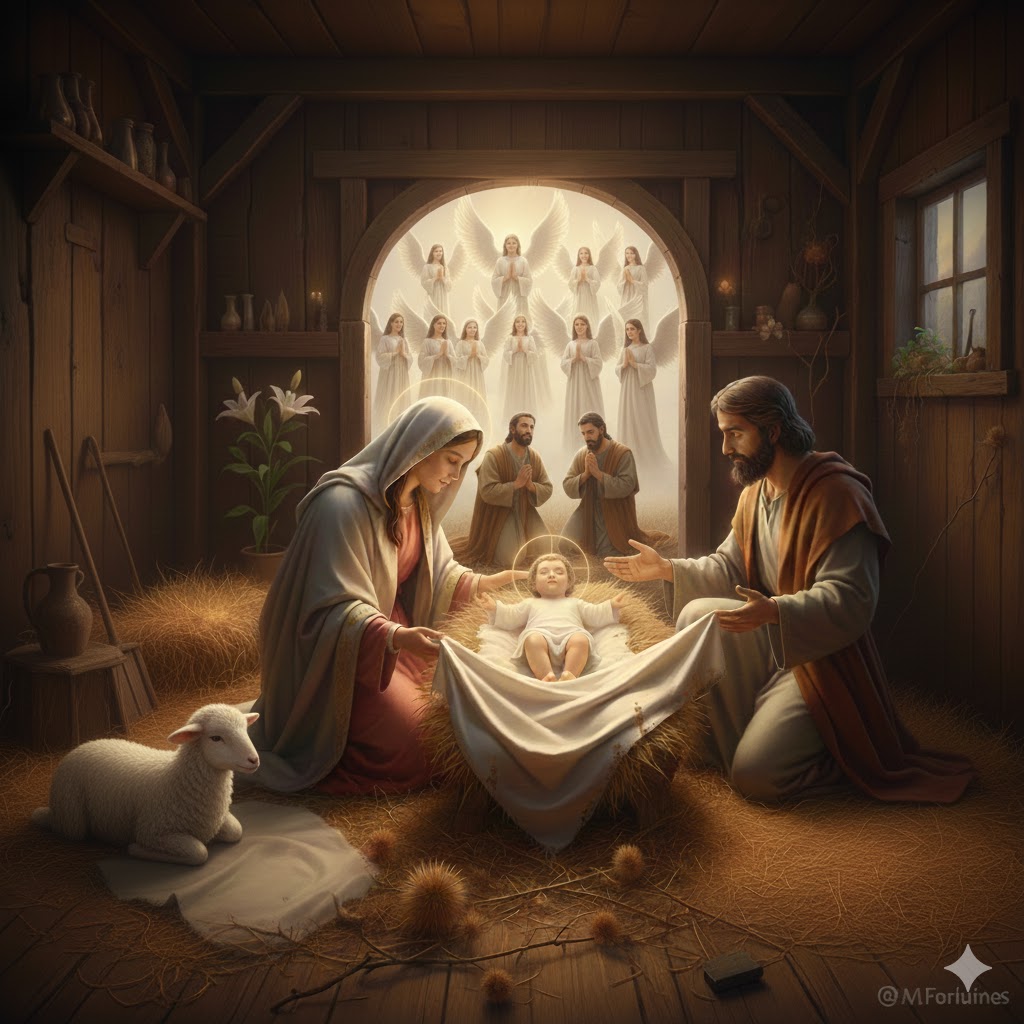
As Silvano Fausti remarked, one of the serpent’s lies was that God is an enemy or a competitor to man. However, one of the things Jesus clearly demonstrated to us is the opposite: God is love, and to love means to desire the good of the other. Therefore, even if there is so much suffering in the world, God has placed a gift of great price within us: free will. Perhaps illness limits my ability to move, but not my ability to think. Thus, instead of the rough straw in the manger of Bethlehem, I place my pain under Jesus, and I cast victimization out—and so, I have gained space. It is a humble place, it’s true, but if Jesus likes it, I offer it to Him.
The Need for Control and the Will of God
Is it easy? No. I would like things to be exactly by the book or according to my own standards of perfection. But that means placing myself on a step above God. This wouldn’t be anything out of the ordinary, considering how much we like to see ourselves as the directors, screenwriters, and lead actors of our own lives. I am in control, I am the architect of my own life. Until the contrary is proven—for example, when an illness strikes, and we cry crocodile tears before the Crucifix. Therefore, I have decided to cast the need for control out of my heart and to wrap Jesus in fidelity to God’s will instead.
But what is the will of God? I recently asked Father I., and he „sent” me to the Decalogue. Everything depends on the love for God. If I offer everything I have (as little as it is!) to Him, He can transform that little into an outpouring of grace. When we consider our own will as a priority, when we think our life plans are more important, when we believe we are the center of the universe, we lose that connection with the Grace that lifts us from our smallness and misery to a much higher reality—one we cannot even imagine, being so limited. This is what God did with Mary. She set aside her plans, desires, and dreams for her life and accepted to follow God’s plan. Let us reflect on this: What was the result of her wise obedience? A new creation. Jesus wiped away our traumatic past, He does not demand payment for our mistakes, and in place of our idea of bitter justice, He put mercy.
Selfishness and God’s Image in My Neighbor
So, what else can I remove from my heart to make room for Jesus? How can we express our love for God other than the way Mary did? Therefore, I can cast out the ambition of thinking that what I know is much wiser than God, who is Wisdom itself.
There is still something in the „room” of my heart that occupies useless space and that Jesus would not like: selfishness. God does not ask me to do His will to satisfy some ego of an omnipotent God. We must trust that God is infinitely more intelligent than we are. No one but Him has a more complete overview of the world. Therefore, if I love God, as Mary did, I do His will.
But I must also realize that God did not create us, nor does He want us to be, like isolated islands in an ocean. Jesus once said: „How can you say you do not love your brother whom you see, but you love God whom you do not see?„. I note here another thing I am casting out: hypocrisy. God created us in His image and likeness. Therefore, if I love Him, I also love His image in my neighbor. To love means to desire the good of the other. Consequently: I take note of their presence, I listen to them, I understand them, I help them, I forgive them, I empathize with them, I respect their opinion, and what is beyond my power, I entrust into the hands of the Lord.
„A Complete Bethlehem”
To return to Monsignor Martinez’s idea of the „complete Bethlehem,” it seems that if I have managed to remove victimization, the need for control, ambition, selfishness, and hypocrisy, enough space has been made for simplicity, fidelity, and love—exactly what Jesus likes.
And you, the one reading this, what things would you take out of your heart if Jesus came today and said to you: „I want to be born in your heart. Prepare a clean place for me”?
 Fereastra spre sens
Lasă un comentariu