Fereastra spre sens

O călătorie de la trauma de plumb la lumina spiritului

  • Read this article in English here.
    Timp de citire: 5 minute

    Mântuiește-mă, Dumnezeule,

    căci apele mi-au ajuns până la gât!

    M-am afundat într-o mlaștină adâncă și n-am nimic de care să mă prind,

    am căzut în adâncurile apei și curentul mă trage cu sine.

    Am ostenit strigând, mi s-a uscat gâtlejul;

    ochii mi s-au împăienjenit așteptând-l pe Dumnezeul meu.

    (Psalmul 69, Biblia Catolică)

    În ”mocirla” depresiei

    Depresia mi-a ”răpit” o parte semnificativă din viață. Ani de zile am fost în psihoterapie încercând să aflu răspunsul la nefericirea și zbuciumul meu. Prima întrebare care se pune în psihoterapie este: ”Ce vrei?”. N-am știut niciodată să răspund prea clar. Nu gândeam în termeni pozitivi, spre exemplu: ”Vreau să fiu fericită”, ci în termeni care exprimau dorința profundă de a evada: ”Vreau să scap de suferință, de vidul interior și uneori… chiar de viață”.

                   Psihologii consideră că oamenii sunt buni în sine. Albert Ellis spunea că și Hitler avea o doză de bunătate pentru că își iubea mama și câinele. Eram prea obosită de gânduri și prea preocupată de propria persoană ca să disting ”razele” de bunătate dintr-un om. Vedeam numai la suprafață și simțeam cu adevărat prezența oamenilor numai când mă deranjau.

    Psihoterapeuții au fost ca a doua familie pentru că m-au învățat să mă autoeduc și mi-au oferit instrumente necesare de autocunoaștere. Dacă eu obișnuiam să despic în patru firul gândurilor și să mă adâncesc și mai mult în depresie, ei m-au învățat cum să despic firul în patru în mod eficient, adică să caut motivațiile profunde din spatele comportamentelor mele și să acționez rațional.

    Întotdeauna ședințele de psihoterapie mă ancorau în realitate, îmi dădeau un sentiment că am un relativ control asupra vieții mele. Asta îmi aducea o oarecare eliberare. Însă ideea că oamenii în sine sunt buni nu m-a convins. Eram convinsă că ”omul este lup omului”, după cum spunea Thomas Hobbes.

    Luminița de la capătul tunelului

    Uitându-mă în jurul meu am constatat că există două categorii de oameni: în prima categorie intră oamenii pe care suferința îi înrăiește și în a doua, oamenii care se ridică deasupra suferinței și o transformă în înțelepciune. Mereu i-am admirat pe cei din a doua categorie. Oare cum reușesc?

    Viktor E. Frankl spunea că suferința te face mai uman în măsura în care îi găsești un sens. Mai degrabă, spunea el, ești bolnav atunci când nimic nu te afectează.

    Pe parcursul anilor însă nu m-am mulțumit să apelez doar la psihologi pentru a mă ”scăpa” de suferință, ci am apelat și la cea mai înaltă autoritate: Dumnezeu. De fapt, chiar așa l-am privit mulți ani: ca pe o autoritate în măsură să mă vindece de depresie. E adevărat că Dumnezeu este atotputernic și poate să vindece orice boală, dar în fața lui Dumnezeu nu merge să te târguiești. Am înțeles în mod greșit că Dumnezeu este acolo sus și e bun doar ca să ne îndeplinească dorințele.

    Greu am ajuns însă să înțeleg adevărata lui natură, nu că ar putea fi cuprinsă cu mintea noastră limitată, dar esența Bibliei, și anume că Dumnezeu este iubire, greu a pătruns în mintea și în sufletul meu.

    Când am înțeles, însă, că Dumnezeu nu este o entitate distantă, ci un Tată iubitor, am început să-mi recapăt identitatea de fiică rătăcită și întoarsă la ospățul dat de Tată în cinstea ei.

    Asta nu înseamnă că depresia a dispărut cu totul, nu înseamnă că problemele s-au dizolvat, însă acum am alți ochi cu care le privesc. Ele nu mă mai îngenunchează, ci au devenit ferestre și uși prin care îl invit pe Dumnezeu în viața mea.

    Chipul lui Dumnezeu în oameni

    Am construit acest blog ca o mărturie a faptului că întunericul nu are ultimul cuvânt de spus și că depresia sau orice altă suferință este o parte firească a vieții. Ce nu este firesc însă este să ne lăsăm învinși, înrăiți și acriți de suferință. Ce pot spune din propria experiență este că, permițându-i lui Dumnezeu și celor apropiați mie să îmi arate ieșirea din întuneric, am început să văd lucrurile dintr-o altă perspectivă.

    Rațiune și credință

    Cel care a avut o influență imensă asupra modului în care înțeleg astăzi creștinismul este episcopul catolic Robert Barron. El a subliniat de multe ori că formele noastre de suferință sau dependență exprimă setea noastră de Dumnezeu care a luat-o pe o cale greșită.

    De curând m-am înscris la cursurile online ale Institutului fondat de el – Word On Fire. Este un spațiu imens în care oamenii își descoperă vieți pline de sens. Una dintre temele foarte des discutate în această comunitate este conflictul modern dintre credință și rațiune, știință și religie. Și eu am avut convingerea mult timp că acestea se află în conflict, dar multe studii din domeniul psihologiei, spre exemplu, demonstrează că virtuțile creștine oferă oamenilor sens și scop în viață.

    Tot psihologii demonstrează că fericirea nu este o stare trecătoare născută din autosuficiență, ci pacea interioară care se naște din siguranța că ești văzut, auzit, ocrotit și iubit de însuși Autorul vieții tale: Dumnezeu.

    Comuniune și recunoștință

    În acest blog voi aborda multe subiecte care explorează relația dintre credință și știință și vă invit în această călătorie să descoperim împreună cum putem ajunge de la întunericul suferinței care poate veni din ”plumbul” traumei la lumina înțelegerii și la bucuria de a fi.

    V-aș fi foarte recunoscătoare dacă ați lăsa un comentariu la ce v-a impresionat fie plăcut, fie neplăcut. Sunt deschisă la păreri diferite și critici constructive. Dacă însă îmi veți spune că o singură idee de aici v-a dat speranță, pentru mine – și cred că pentru oricine – va fi dovada supremă că Dumnezeu lucrează într-un mod minunat.

    Voi ce credeți: poate fi găsit un sens în suferință?

  • Citește acest articol în română aici.

    Reading time: 7 minutes

    The „Carpet” of Mud

    Last night I couldn’t sleep. The story of a little girl came to my mind. A girl no older than 7 or 8, with chestnut hair and large brown eyes, frightened and sad at the same time. Poorly dressed, with mud on her face and hands. She lived in a wooden cabin so small she could touch the ceiling with her hand, and through its cracks, one could see the cloudy and rainy sky of late autumn. If she opened the door, all she could see around her were bare and gloomy trees, and on the ground, a „carpet” of mud.

    What could have happened to this little girl? How did she end up here? To be honest, tonight I didn’t have enough time, nor a great enough curiosity, to read the story from the very beginning. That would mean going all the way back to Adam and Eve. It’s too much. Father I. used to tell me that we must focus on the essential, so I tried to extract the essence of this story.

    The Mountain „I Am Who I Am”

    At one point, I see the girl on the edge of a precipice. On one side, „Lucifer’s Chasm,” for that was its name. Someone said that there lies the abyss of pride, selfishness, and self-love. There is no point in describing it; everyone can know it by analyzing their own abyss. On the other side, a tall mountain whose peak was hidden by dense clouds. It was called the mountain „I Am Who I Am.” The girl did not understand this, but she had a vague intuition that she would find something better there than what her life had been until then.

    It is not known how many days and nights she climbed that mountain, how many bruises, scratches, and wounds she sustained from the steep rocks, or on how many paths she got lost through wind and rain. What is known is that, at one point, her heart felt like lead. She lay down on the carpet of cold, damp leaves and refused to get up again, even though she had a vague intuition that she could have gone just a little further.

    Not long after, she fell into a deep, dreamless sleep, like when you know you are in a tunnel of complete darkness—a dense darkness—and you watch helplessly as someone steals your hope. As if in a dream, she felt herself at one point being lifted from the cold, damp carpet, and something very strong was gripping her waist. Her heavy eyelids barely opened, and she saw that she was a prisoner in the talons of an eagle rising higher and higher toward the sky. Once again, she felt that someone was stealing her hope, and she retreated back into a heavy sleep.

    The Palace Adventure

    It is not known how long that journey lasted. What is known, however, is that at one point she woke up and saw a palace rising before her. It did not seem like the palaces from her stories—it wasn’t that tall, nor did it have an elegant architecture; instead, it was a dull grey color. Nevertheless, curiosity drove her; she opened the palace door and went inside. Suddenly, a powerful light struck her. She managed to open her eyes and saw large, wide windows through which the sun entered generously. That light made the golden walls and crystal chandeliers shimmer. Yet, that bright room, flooded with sunshine, was empty. „Did I fight to get here for nothing? Is there really no one in this palace?” Looking around, she eventually saw a narrow door that could be reached by climbing many steps.

    She climbed the steps anyway, reached the door, and opened it; before her lay another set of steps that spiraled up toward the palace tower, and they were very narrow. On the wall was a sign showing an arrow pointing up, which read „Hope.” She began to climb the steps. 10, 20, 30, 100… The wounds on her feet deepened, and the pain became unbearable. She stopped with a certain intuition that it wasn’t much further to the top. Out of curiosity, she looked back to see how far she had climbed and noticed, to her surprise, a plaque that no longer showed an arrow pointing up, but down, and it no longer read „Hope,” but „Doubt.” Suddenly, she lost her balance and tumbled down. 10, 20, 30, 100 steps…

    The Silk Dress

    It is not known how long she lay there. What is certain is that she woke up at some point in the same hall she had started from, at the palace entrance. This time, however, the hall was full of people making an incredible, joyful noise. She couldn’t believe it. People?! And joyful, at that?! She saw a small chair, just her size, in the corner of the room and headed there to sit down, apparently unnoticed by anyone.

    She sat on the chair, fearful and cautious, while admiring the noisy and cheerful crowd. Suddenly, the door to the spiral staircase opened, and a middle-aged man appeared. He descended the stairs quickly, looked at her suspiciously, and headed straight toward her. He reached her and asked: „Who are you? How did you enter my palace so dirty?” The girl opened her large eyes, which filled with fear, and did not dare to say a word. The man turned furiously toward the servants and shouted: „Submerge her in water! But not in a river, in an ocean! She is very dirty! Then, give her a silk dress woven by seraphim! All children in the Palace are clean! Filth stays at the door! Come on! What are you waiting for?”

    It is not known what process the girl went through, but the point is that she appeared in the hall before the middle-aged man, transformed. „Now, you will sit next to me at the table,” the man told the girl. „Well, what do you think? How does it seem to you now?” he asked her. „Why are you silent? This is a banquet, everyone is having fun! Do you have nothing to say?” „Yes, I do,” the girl said. „I want to go back home.” Suddenly, a heavy silence fell over the hall. „What?!” the man asked, indignant. „I took you out of the mud and brought you into a palace hall, and you want to go back home?! For My Name’s sake! Why?” Fearfully, the girl told him: „Because I want to bring my parents and my siblings here too.”

    „Incredible!” the man shouted in indignation. „Very well! If that is what you want! The door is there! You may leave!” The girl stood up slowly and started with unsteady steps toward the exit. She was convinced she would be covered in wounds again while descending the mountain and that she would reach the forest where she had left her parents and siblings with great difficulty, or perhaps never. Yet, the last shred of hope gave her strength.

    The Wings of Freedom

    She opens the door, steps out, and before her appears a woman of unseen beauty, clothed with the sun and with the moon under her feet. The woman leans toward her and asks: „Where are you going?”. „I am going to bring my parents and my siblings here.” The light on the woman’s face begins to take shape and transforms into a wide smile, so warm that it melts the ice of doubt and fear in the girl’s heart. Then the Woman says to her: „If you set out on your journey, do not forget: with hope, you travel on eagle’s wings; with faith, you reach your destination; and with love, you return in safety.”

    It is not known what happened to the girl. Is she on her way to the forest or back to the Palace? It is not known. What is certain, amazing, and strange is that through the darkness she found a way of communication with her Father. This way of communication has always existed and exists for everyone. Praise be to the Lord!

  • Citește acest articol în română aici.

    Reading time: 4 minutes

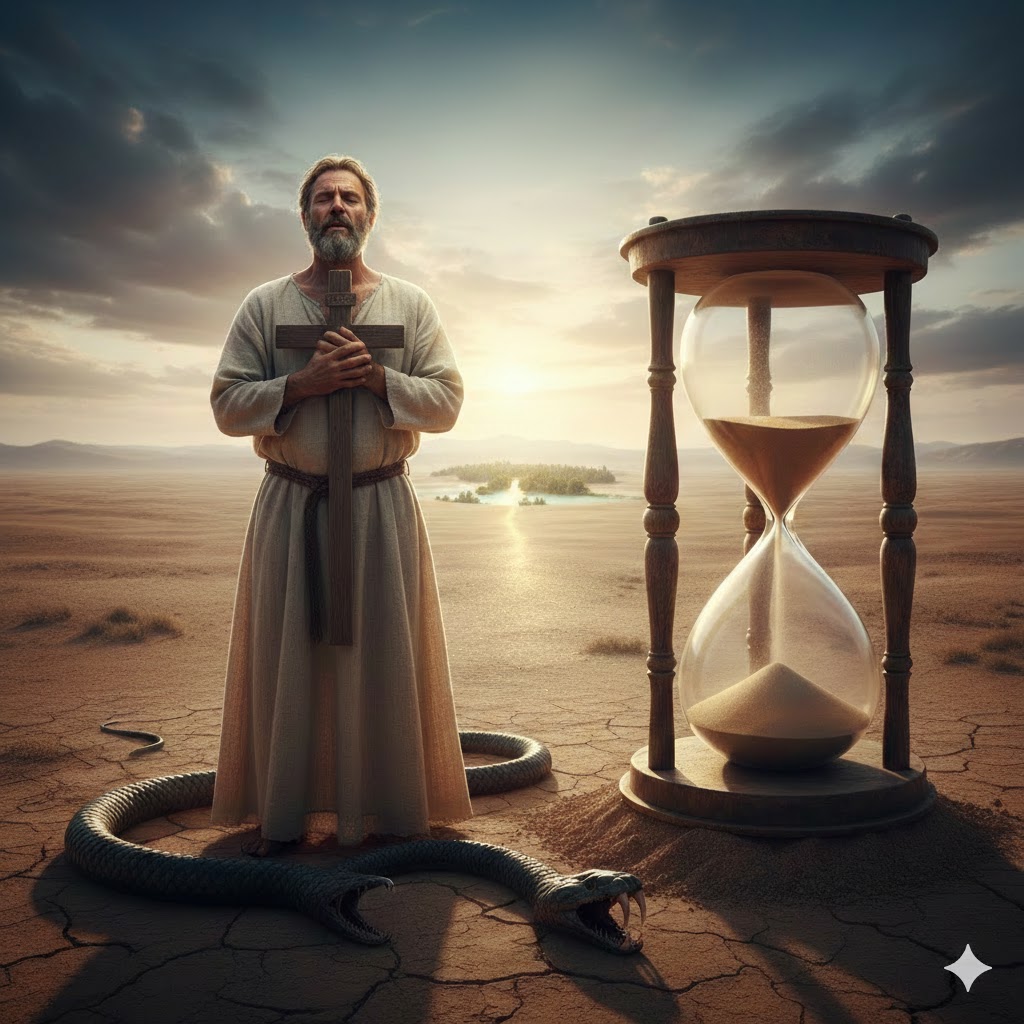
    A man was wandering in the desert on a scorching summer day. The sandstorm had covered all the roads, and he no longer had any clue where he was or where he was headed. He tried to look around, but the sand got into his eyes, and he could see nothing. Miraculously, the storm began to decrease in intensity, the wind died down, and the sea of sand unfolded around him, covering any trace that could have led him home.

    „Now what do I do? Which way do I turn? Which direction can lead me back to civilization? How much distance will I have to cover? I have no water, no food. How long will I survive? Or, better yet, will I survive?” These questions gnawed at the man for a while. Then, he stood up abruptly: „Any direction is better than standing still!” he told himself.

    And he set off, treading laboriously through the sea of sand. Looking around, an hourglass involuntarily came to his mind. Time was slipping away irreversibly, and the sand trickling through the hourglass sent shivers down his spine.

    The sun slowly began to head toward sunset. „Soon, evening will fall over the desert. What will I do?” he thought. Heat and exhaustion made him stop. „I’ll rest a little, then I’ll set off again.”

    He sat on the sand, breathed deeply, stretched his legs, and his eyes remained fixed on the ground, feeling an inner void engulf him.

    A few steps in front of him, the sand began to move. „Oh no!” he said to himself. „Is the storm starting again?” But then, from the sand, a snake began to emerge. Its golden skin reflected the sun, giving the impression of moving gold.

    The man felt the sweat on him begin to turn into ice, the blood in his veins the same; his pupils dilated, and all he could feel was his heart threatening to leap out of his chest.

    But that wasn’t the only surprise. The snake raised its head, looked at him fixedly, opened its mouth, and… began to speak:

    • You’re afraid, aren’t you?

    Silence…

    • You’re tormented by the doubt of whether I am a product of your imagination or if I am real. It’s simple. Try to move and you’ll find out.

    Silence…

    • I feel sorry for you, being lost here, but I could help you. I can show you the correct direction. It’s not much further. But I want something in exchange. What will you give me?

    Silence…

    • I know you’re thinking now about what you could give me just to escape. I’ll tell you, since you aren’t speaking: I want your brother’s life. I know he is a doctor and has sacrificed many of my brothers, taking their venom to use for medicine. What do you say? Do you value your life?

    The man gathered his courage, moved his right hand, and brought it slowly to his chest, then to his neck where he wore a chain with a cross. He gripped the cross in his hand, opened his mouth, and with great difficulty began to say: „Our Father…”

    The snake raised its head even higher and said to him:

    • Do you really believe in those stories? Look, I am standing in front of you, I am real, but where is your Father? Why doesn’t He save you? Let me tell you a story: it is said that in ancient times, a father disinherited his son because he was jealous of his intelligence and beauty. Do you really believe such a Father will save you?

    From pale, the man began to turn red with anger.

    • How much longer must I endure your lies, snake? The desert is not a place of perdition for me. Now I have truly realized who I am and what is most important in life. You tell stories, but I will tell you the Truth: the One who took the venom of your brothers exposed the lie and brought the Truth, and with this Truth, He healed the wounds of the sons of that Father you speak of. It wasn’t jealousy that made Him disinherit you, but your madness. You say you are real, but the eyes of the mind can deceive if we go by appearances. I see the Father with my heart, which is part of His heart. If He were to deceive me, He would deceive Himself. A kingdom divided against itself cannot stand. And finally, my Brother, who tore away the venom of your brothers, tore away yours as well. You are powerless, snake!

    Then the man stood up courageously, grabbed the snake by the neck and tail, lifted it above his head, and threw it far away.

    What happened next to the man is not known, but even if he wandered through the desert further, he knew the true Way within his heart. The Truth set him free from fear, and he understood that his life is precious to the Father.

  • Citește acest articol în română aici.

    Reading time: 5 minutes

    Recently, Father I. recommended a text written by Monsignor Luis Maria Martinez. It consists of three meditations titled „How to Receive Jesus Who Comes.” These meditations possess an irresistible depth and warmth that have made me seriously reflect on how I welcome Jesus into my heart.

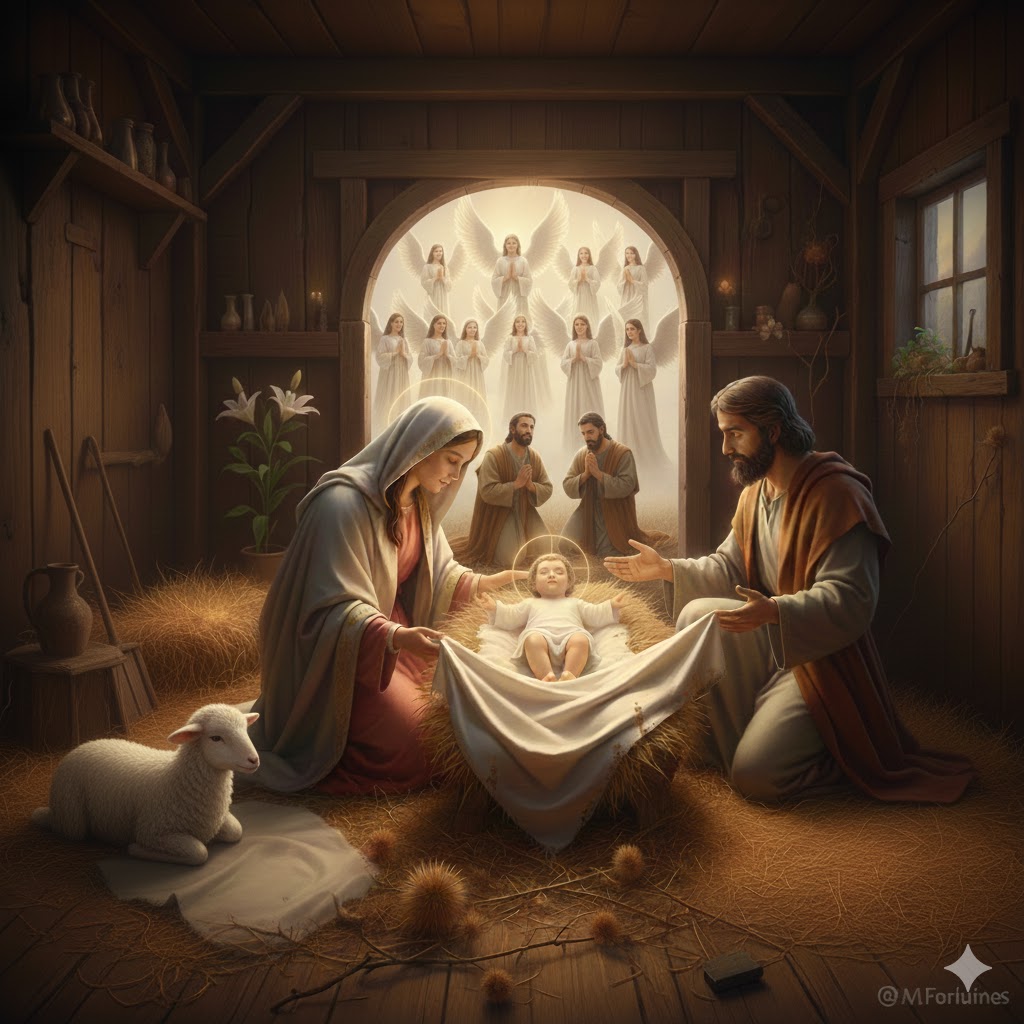
    Monsignor Martinez says that we must be a „complete Bethlehem” to be able to receive Jesus. That is: the humility of the stable, the fidelity of Joseph, and the maternal and tender love of Mary. It seemed to me that he was asking too much. A „complete Bethlehem”?! Couldn’t we just choose? Well, the author says no. We must be „complete.”

    Victimization and Free Will

    Christmas is approaching, Jesus wants to be born, and He has chosen my heart. How do I prepare it? What would I take out of my heart to make room for Him? Given that until now I have defined myself only through the diagnoses received from doctors, perhaps the first thing I should remove from my heart is victimization. I do not deny my suffering, I do not hide it, but I try to understand it and live with it. We are not perfect; God does not love us because we are perfect, but, as Monsignor Martinez says, He is attracted to our „misery.” Why? Because He can transform our „trash” into gold.

    As Silvano Fausti remarked, one of the serpent’s lies was that God is an enemy or a competitor to man. However, one of the things Jesus clearly demonstrated to us is the opposite: God is love, and to love means to desire the good of the other. Therefore, even if there is so much suffering in the world, God has placed a gift of great price within us: free will. Perhaps illness limits my ability to move, but not my ability to think. Thus, instead of the rough straw in the manger of Bethlehem, I place my pain under Jesus, and I cast victimization out—and so, I have gained space. It is a humble place, it’s true, but if Jesus likes it, I offer it to Him.

    The Need for Control and the Will of God

    Is it easy? No. I would like things to be exactly by the book or according to my own standards of perfection. But that means placing myself on a step above God. This wouldn’t be anything out of the ordinary, considering how much we like to see ourselves as the directors, screenwriters, and lead actors of our own lives. I am in control, I am the architect of my own life. Until the contrary is proven—for example, when an illness strikes, and we cry crocodile tears before the Crucifix. Therefore, I have decided to cast the need for control out of my heart and to wrap Jesus in fidelity to God’s will instead.

    But what is the will of God? I recently asked Father I., and he „sent” me to the Decalogue. Everything depends on the love for God. If I offer everything I have (as little as it is!) to Him, He can transform that little into an outpouring of grace. When we consider our own will as a priority, when we think our life plans are more important, when we believe we are the center of the universe, we lose that connection with the Grace that lifts us from our smallness and misery to a much higher reality—one we cannot even imagine, being so limited. This is what God did with Mary. She set aside her plans, desires, and dreams for her life and accepted to follow God’s plan. Let us reflect on this: What was the result of her wise obedience? A new creation. Jesus wiped away our traumatic past, He does not demand payment for our mistakes, and in place of our idea of bitter justice, He put mercy.

    Selfishness and God’s Image in My Neighbor

    So, what else can I remove from my heart to make room for Jesus? How can we express our love for God other than the way Mary did? Therefore, I can cast out the ambition of thinking that what I know is much wiser than God, who is Wisdom itself.

    There is still something in the „room” of my heart that occupies useless space and that Jesus would not like: selfishness. God does not ask me to do His will to satisfy some ego of an omnipotent God. We must trust that God is infinitely more intelligent than we are. No one but Him has a more complete overview of the world. Therefore, if I love God, as Mary did, I do His will.

    But I must also realize that God did not create us, nor does He want us to be, like isolated islands in an ocean. Jesus once said: „How can you say you do not love your brother whom you see, but you love God whom you do not see?. I note here another thing I am casting out: hypocrisy. God created us in His image and likeness. Therefore, if I love Him, I also love His image in my neighbor. To love means to desire the good of the other. Consequently: I take note of their presence, I listen to them, I understand them, I help them, I forgive them, I empathize with them, I respect their opinion, and what is beyond my power, I entrust into the hands of the Lord.

    „A Complete Bethlehem”

    To return to Monsignor Martinez’s idea of the „complete Bethlehem,” it seems that if I have managed to remove victimization, the need for control, ambition, selfishness, and hypocrisy, enough space has been made for simplicity, fidelity, and love—exactly what Jesus likes.

    And you, the one reading this, what things would you take out of your heart if Jesus came today and said to you: „I want to be born in your heart. Prepare a clean place for me”?

  • Citește acest articol în română aici.

    Reading time: 6 minutes

    A Mysterious Sculptor

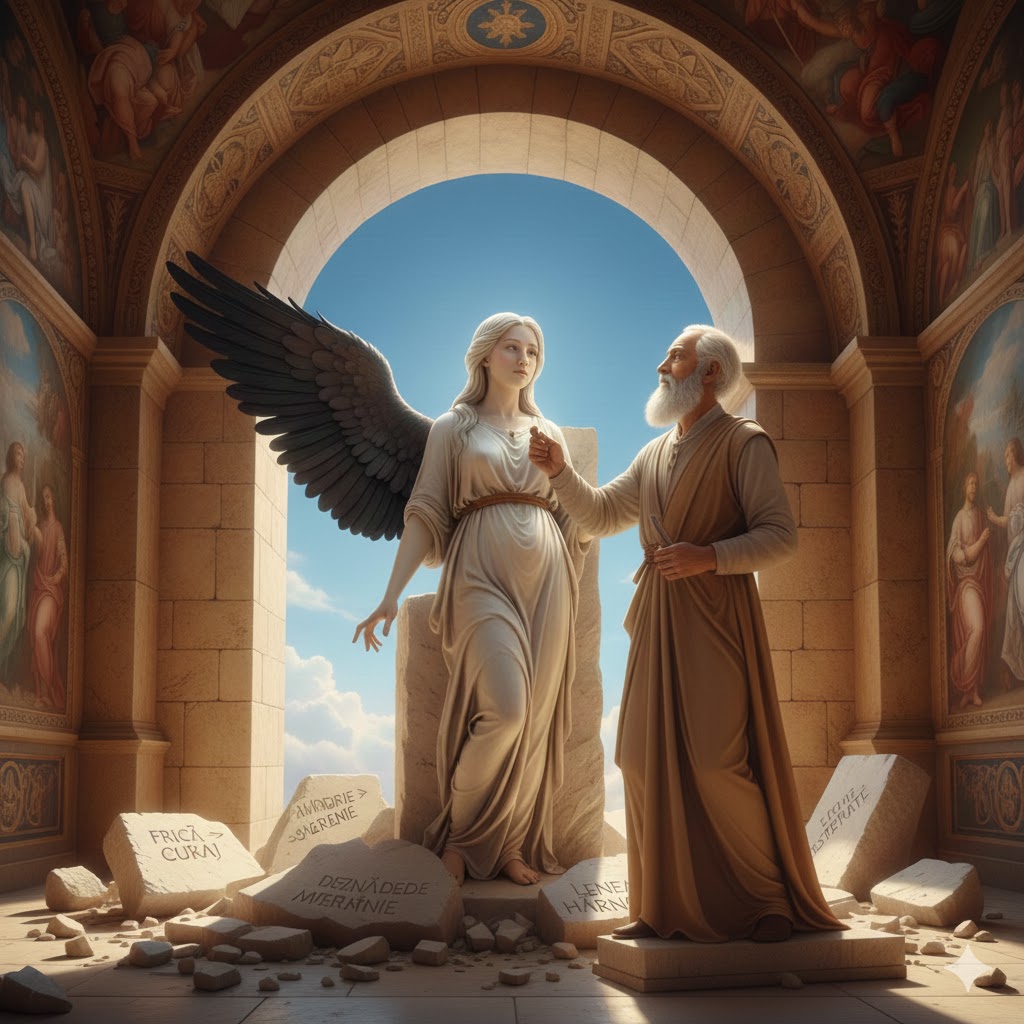
    Av-Yotzer is a sculptor who has never known fame, being known only by his family and a few friends. A middle-aged man, he has appeared unchanged for as long as I have known him. Sometimes he seems to look right through you; at other times, he seems to gaze into the very depths of your soul, where no one else can penetrate. He lives at 3 Eden Street, in the heart of the city. His house has an architecture that calls to mind the Renaissance period. The lower part of the house is made of rough stone, but as it rises, the stone becomes increasingly fine and polished. The entrance doors are tall, preceded by a dome supported by two columns. The house is built around a square inner courtyard, far from the noise of the street, where Av-Yotzer has his creative studio.

    I met him personally only recently when, while I was recovering from surgery, my husband asked him to sculpt an angel for my collection. He sculpted an angel kneeling with eyes closed and hands clasped as if in prayer. I placed it on the nightstand beside my bed, and whenever I look at it, I feel the pain caused by my illness decrease in intensity, and I, too, can join my hands in prayer.

    The Mystery in the Creative Studio

    A block of marble, nearly as tall as Av-Yotzer, stood in the middle of the inner courtyard. It had a rough shape, and I did not know his plans. He hadn’t told me what work he intended to carve from that stone. Next to the marble was a table with all kinds of tools a sculptor might need. He looked carefully at the table, chose a heavy, sharp chisel, and then began to analyze the stone from every angle. At one point, he stopped, fixed his gaze on a single spot on the stone, and slowly began to carve.

    The first strike of the chisel made me freeze. It wasn’t so much the sound of the tool as it was a cry of pain heard from deep within the stone. Fear paralyzed me. I refused to believe the cry was coming from inside the marble and comforted myself with the idea that it came from somewhere else. But every blow Av-Yotzer struck against the stone triggered another cry of pain.

    A strange mixture of curiosity and fear kept me glued to my chair, my eyes fixed on Av-Yotzer and the stone, losing all sense of time. The cries that followed every strike did not seem to disturb the artist, who continued his work with infinite patience. The dust, the noise, and the exhaustion from the effort did not seem to touch him as he precisely calculated his blows and carved the stone.

    The Soul Within the Stone

    His face bore an iron determination and a certainty that what he would bring out of that marble would be a masterpiece. Still, I wondered: perhaps Av-Yotzer knows what he is doing, but I do not understand where he wants to go, and above all, I do not understand where these cries are coming from. At one point, I gathered my courage and asked him:

    • Av-Yotzer, where are these cries coming from?
    • From the stone, he answered impassively.
    • I don’t understand, Av-Yotzer, how can a stone cry out? It is against the laws of nature. Only humans have voices, I told him, intrigued.
    • If you have patience, you will understand.
    • Av-Yotzer, I have patience, but if there is a person inside crying out in pain, how can we be indifferent and not do something to help?
    • We cannot help if we do not cast the stone aside, and for that, focus and patience are needed, because one wrong strike of the chisel could end their life.
    • Fine, Av-Yotzer, but how did that person end up inside the stone?
    • Through a long process. The stone gradually deposited itself upon their body.
    • And how do they have air? I asked him.
    • They anesthetized themselves, like the crucian goldfish that survives without oxygen under the frozen surface of the water.
    • Strange, I replied.
    • What caused the stone to deposit on their body?
    • The first layer that formed on the body was caused by fear. The people who were supposed to care for them abused them. Then, pride followed. Living in isolation, he believed he was special, above everyone else. He began to believe that everything around him was his due, and he fell into licentiousness. Having a shred of conscience, he stopped, but soon fell into despair. That is the thickest layer. Being so closed off, he became envious of others’ achievements. Refusing the lifelines I reached out to save him, he slipped into sloth, and there he remained.
    • It’s amazing, Av-Yotzer! I am very curious to see what that person will look like after you remove all the layers.

    In the Mirror

    Av-Yotzer sank back into silence, and as I watched the marble block closely, I noticed it beginning to take shape; the details of a human face were emerging in relief. It was a face that, strangely, seemed familiar. And then, at the end of the polishing process, my vague sense of familiarity turned into wonder, and wonder soon turned into shock. It was as if a mirror had been placed in front of me. The statue represented a woman dressed in a golden silk dress, seated in an armchair. Just like me! Then I looked at the facial features: large brown eyes, a rounded nose, well-defined lips. Wavy, chocolate-colored hair. I don’t know how long I remained frozen, but at one point I felt I could breathe again, and I asked Av-Yotzer:

    • Av-Yotzer, how is it possible? The woman you brought out of the marble is me!
    • I haven’t finished the polishing process yet, Av-Yotzer told me. There are still a few details that will make the difference, and my breath will give her life. Barely recovering from the shock, I asked him, bewildered:
    • And what are these details?
    • Well, he told me, I have transformed fear into courage, pride into humility, licentiousness into freedom, despair into hope, envy into compassion, and sloth into diligence.

    Looking into his eyes, I realized that as he spoke, he was watching me with infinite tenderness. Then he said:

    • This is how I created you from the very beginning, but I left you free to choose what you would do. After I finish the final touches, this woman will remain a statue that you can take home. I will leave you free again so that, following her model, you may remove the layers that keep you captive yourself. You have the breath of life from me, and that is enough for you.

    “I will remove the heart of stone from your flesh and give you a heart of flesh.” (Ezekiel 36:26)

  • Citește acest articol în română aici.

    Reading time: 4 minutes

    I was recently diagnosed with hip osteoarthritis (coxarthrosis). This disease creates pains that sometimes feel like they take your breath away, limiting your movement to absolute rest. Lying in bed, I fell asleep and had a dream. This is what happened:

    “A Ravishing Beauty”

    I was lying in bed, feeling my body as if it were gripped in a vice because of the pain. Suddenly, I felt a breeze. I looked toward the window to see if it was open. It wasn’t. My gaze was drawn to a light that was seeping more and more through the ceiling, which was slowly disappearing until, behold, before me unfolded a sky so beautiful, clear, and blue.

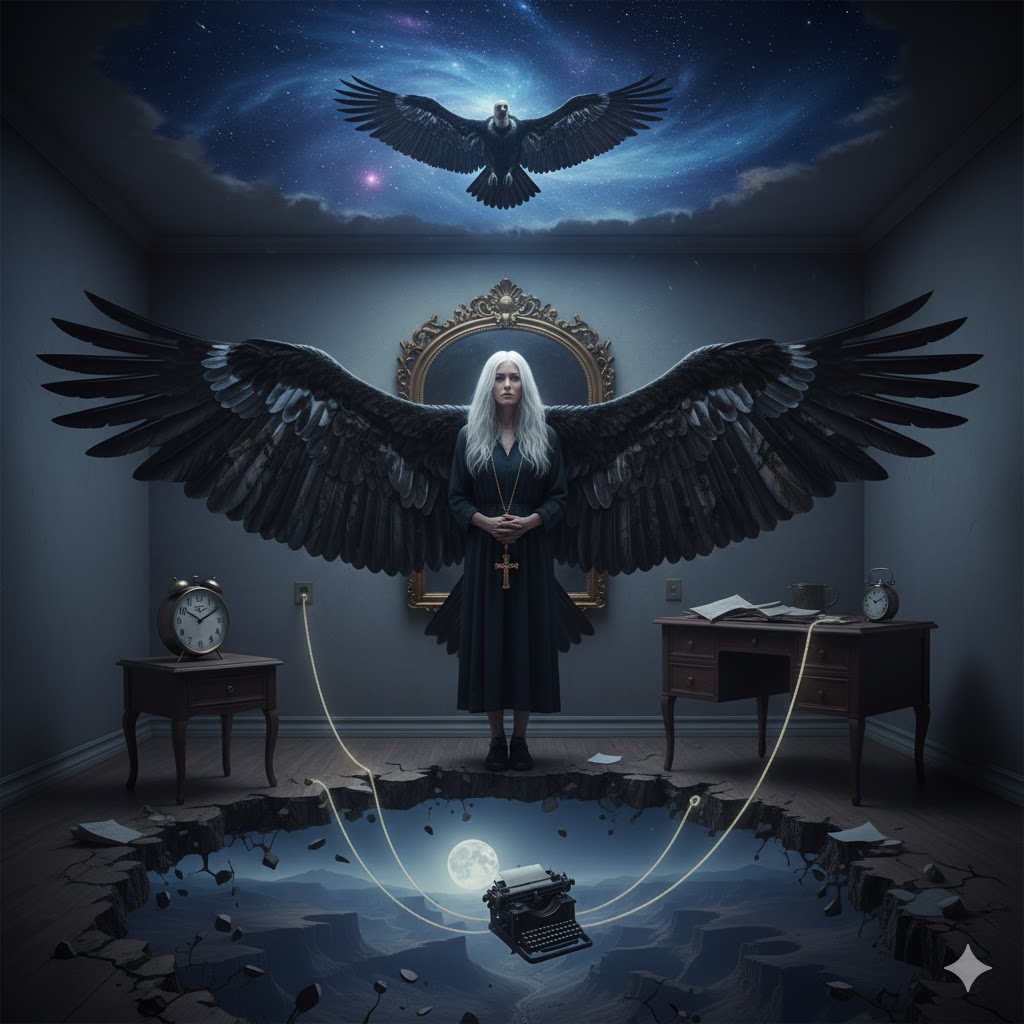
    The room’s window opened, light poured in, and with it, an eagle appeared, perched right on the windowsill. It was so large that the rays of light could hardly penetrate the room. Its yellow eyes with black pupils looked at me with coldness, but at the same time with a kind of curiosity, as if asking me: “What are you doing? Pitying yourself?” I looked back at it, curious and impressed by its beauty. It had a white head and tail, while its body and wings were black as a deep night. Its talons were long and curved, and looking at them, they brought to mind the expression: “ravishing beauty.”

    Although I had shivers down my spine looking into its eyes and at its imposing appearance, at one point, I felt a strong temptation to approach and stroke it. Despite the pain, I made an effort to get out of bed and drew near, but the eagle turned its head toward the sky that had melted the ceiling, spread its wings, took flight, and began to glide above my room, continuing to watch me.

    Between the Abyss and the Heights

    Suddenly, the idea came to me to immortalize the moment—after all, you don’t see an eagle gliding above your room every day, in a sky that has just made the ceiling vanish. I went to my desk, sat down, took a pen and a piece of paper, and began to describe the astonishing image unfolding before my eyes.

    At one point, I felt the floor tremble and begin to disappear, leaving only the section where I was sitting at the desk. I looked down and saw a chasm so deep that I forgot myself, feeling only a warm breeze rising from the depths. I heard the sound of wings; the eagle began to soar higher and higher toward the sky, and my vision became so sharp that I could see it in the smallest detail, even as it moved further and further away from me.

    All at once, the words of Saint Paul the Apostle came to mind: “We are afflicted in every way, but not crushed; perplexed, but not driven to despair; persecuted, but not forsaken; struck down, but not destroyed” (2 Corinthians 4:8-9). The higher the eagle soared, the sharper my gaze became as it followed him. As he rose, pulling my gaze along with him, I felt the pain begin to vanish, giving way to a pleasant sensation of fascination and freedom.

    Peace in the Storm

    On the sky, however, black clouds begin to gather, and the wind grows increasingly stronger. A torrential rain begins to fall from the clouds. The storm unleashes its fury, but the eagle does not lose its balance; it does not hide among the rocks, but continues to fly, and the powerful wind pushes it beyond the clouds to where the sky is clear and blue.

    I remembered the peaceful sleep of Jesus in the boat on the turbulent sea during the storm. The eagle’s peace was just like the peace of Jesus—undisturbed by the threatening storm, knowing that the gale is but an impulse to soar even higher in spirit. King David was in a similar „storm” when he said: “Even though I walk through the valley of the shadow of death, I will fear no evil, for You are with me.”

    Reality with Wings

    The eagle soars higher and higher, but my eyes grow tired; I close them and wake up in my room. I try to move, but I feel the sharpness of the pain. I look up and see the ceiling; I look toward the window and see it is closed; I look at the clock and see the second hand moving with a defying precision. I make an effort to stand up, I reach the mirror, and I am left perplexed: my hair was white, and in place of my arms, black wings had grown.

  • Citește acest articol în română aici.

    Reading time: 4 minutes

    On December 28, 2025, Catholic Christians celebrated the Holy Family: Jesus, Mary, and Joseph. Priests wear white (or white-gold), a color worn at Easter and Christmas, symbolizing the triumph of life over death and light over darkness.

    The Reality of the Road to Egypt

    One might think that in the Holy Family there was only peace, serenity, and joy. But it was not so. On the Feast of the Holy Family, the Gospel depicts the flight into Egypt. To save the Child from Herod’s wrath, Joseph and Mary venture onto a road full of dangers. At that time, there were no streets, highways, cars, or airplanes. Roads meant risk: facing thieves, criminals, wild animals, and the whims of the weather. It is very interesting to see how God chooses to be born and to live in the very heart of our weakness and malice. Could He not have sent an army of angels to carry Jesus to Egypt?

    God Looks Beyond Appearances and Masks

    It seems that God has rather strange ways. He likes to work in secret, beyond appearances—unlike us humans, who judge most of the time based precisely on these appearances: because it’s easier, because it’s more convenient, because we lack patience.

    I have always been the “black sheep” of the family. Either I wandered and couldn’t find my place anywhere, or I was struck by all kinds of illnesses and tested them from every point of view. Most of the time, I felt misunderstood and kept my distance. But since God loves to work beyond appearances, He made it possible for us to see beyond the masks.

    Sometimes we wear the mask of pride: we want to give the impression that we are fine and do not need the person next to us. Other times we wear the mask of sabotage: I am sad because my family does not fulfill all my desires. There are also moments when we adopt the mask of mistrust, and that is when ruptures in relationships occur. Before God, however, all masks fall.

    The Road to Egypt Is the Road to Each Other’s Hearts

    Thus, over time and through God’s Grace, I discovered that my family has been for me both Jesus, Mary, and Joseph. Why do I say this? They were Jesus because they saved my life, so that in time I would learn to appreciate it. They were Mary because they offered me warmth. And they were Joseph because they protected my fragility.

    Of course, no one is perfect. They made mistakes too. Disappointments were mutual, but God, through His mysterious ways, gave us the courage to look into one another’s souls and learn to forgive. It seems that sometimes, the „road to Egypt” is actually the difficulty of reaching the heart of the other.

    Every year in December, Catholics celebrate the Holy Family because Jesus made His family our family as well. Without their guidance, we would not have been able to look into our souls with sincerity, to know our limits, and to relate to a higher reality, without which life is so dry and a prisoner of appearances.

    Therefore, people of good faith, let us drop the masks and look deep into our souls where, as Saint Paul the Apostle says, Christ Himself dwells, who can lead us to a new life full of love and forgiveness.

    “Put on then, as God’s chosen ones, holy and beloved, compassionate hearts, kindness, humility, meekness, and patience, bearing with one another and, if one has a complaint against another, forgiving each other; as the Lord has forgiven you, so you also must forgive. And above all these put on love, which binds everything together in perfect harmony. And let the peace of Christ rule in your hearts, to which indeed you were called in one body. And be thankful. Let the word of Christ dwell in you richly.”

    Matthew 2:13-15, 19-23

    Colossians 3:12-16

  • Citește acest articol în română aici.

    Reading time: 4 minutes

    The Mother of the Divine Child

    The first title granted to the Virgin Mary by Christians was „Mother of God” (Theotokos). This is how she is celebrated every year on January 1st in the Catholic Church.

    The Gospel speaks of the episode in which the shepherds go to worship before the Child in the manger and then spread the news of His Birth, full of joy and veneration toward God.

    From Ego-drama to Theo-drama

    I would like to focus on what the Evangelist Luke says in this text: “But Mary treasured all these words, pondering them in her heart.” What was Mary pondering?

    The American Bishop Robert Barron makes a very interesting distinction between “ego-drama” and “theo-drama.” “Ego-drama” is what we choose to be; we forge our own destiny, we are in control, and we are the directors, actors, and screenwriters of our own lives. God is excluded. In “theo-drama,” on the other hand, we have a supporting role, while the direction and the script are signed by God. What we must do is find our role within this “theo-drama.” In other words, in Christian language, to find our mission. This is what Mary did par excellence.

    She understood that before God, one must abandon the ego-drama. It all began with those words addressed to the Archangel Gabriel, the famous “Fiat”: “Behold the handmaid of the Lord. Let it be done to me according to your word.” Finding her mission gives Mary wings; her horizon expands, she acquires meaning and purpose, and she gains spiritual power and depth—a depth so profound that it could contain the Word of God, to whom she gave birth in the form of a Child.

    What It Means to Do God’s Will

    What would have happened if Mary had refused this mission out of fear of being judged or marginalized? She would have remained a woman with a narrow horizon, of whom no one would have ever heard. By doing the Lord’s will, however, Mary changed the course of history. Thus, following her example, it would be beautiful if we could acquire an unshakable trust that God has plans for us that are infinitely better than the plans we have for our own lives.

    This does not mean that doing God’s will implies walking serenely through a field of flowers. However, knowing that you are not alone in the spiritual struggle and that God does not allow evil to destroy you, but to bring an even greater good out of it, uplifts your soul beyond any „misery.”

    As for me, I try to view life’s trials as a „Furnace of the Spirit.” As much as illness, weakness, or failure pull me down, to the extent that I put my trust in God, they become a springboard that flings me into His arms.

    Writing now, I think of nothing else but doing His will and being a witness to His infinite mercy and love. Bishop Barron also said: “Your life is not about you.” To some, it seems ridiculous. To others, terrifying. To others, it’s a matter of indifference. But those who have „tasted” the feeling of abandoning themselves into God’s hands know how wonderful it is to behold the free movements of the soul.

    And while suffering crushes many, surrendering into God’s hands transforms your suffering into a „cell”—a monk’s chamber—where the soul is refined by fire; a fire that does not burn, but transforms this „cell” into a place of light, a place of encounter with Christ.

    Mary – Our Guide in Finding Our Mission

    What was Mary pondering in her heart? Surely, she pondered her mission and, above all, the mission of the Incarnate Word. Doing God’s will does not mean you always know where you are headed. Many times you are uncertain, you feel lost, you have the impression that God has forgotten you; but as Caryl Houselander said: “God’s silence is, in fact, an embrace so tight that there is no longer any room for words”

    Mary sacrificed herself for the Incarnate Word and, at the same time, for each of us. And she continues to sacrifice her „time” in eternity to help us find our mission just as she found hers: through deep prayer in a soul full of peace and trust in God’s will.

    Have you thought about which drama you are playing in: ego-drama or theo-drama?

  • Citește acest articol în română aici.

    Reading time: 4 minutes

    Writing is a form of therapy for me, a „motor” that uplifts my spirit. It helps me look at my own past with honesty, to detach myself from the pain, and to find its meaning.

    The book „Spirit and Meaning” is a testimony of darkness overcome by light through Christianity and Viktor E. Frankl’s logotherapy.

    In the following sections, I have selected a few fragments from the nine chapters. I wrote this book for you—the one facing depression or a lack of meaning in life—but also for you, the skeptic who does not believe in the power of the spirit over matter. Who knows? If one day a single sentence gives you a ray of hope, then this book has fulfilled its mission.

    “…then I stood up, stretched on my toes, extended my arms gracefully as if I had wings, and began to spin in a circle. In that moment, I felt the lead on my wings melt away, making room for a powerful air of freedom and movement. I don’t know how high I soared then, but in any case, I rose above the daily hell.”

    “…the main character, Jesus, fascinated me completely. He seemed to be a ‘Man after my own heart.’ Besides performing miracles, He spoke about a ‘Kingdom.’ My imagination began to take flight.”

    “…I do not regret the suffering of love either, because it gave wings to my imagination and depth to my soul.”

    “Surprised by my reaction, he stood up and looked at me in wonder. Instinctively, I began to strike him with my palms and scratch his face. He tried to stop me, but I broke away and punched the windowpane. After the shards scattered across the floor, I noticed my hand beginning to bleed. I still carry the scar.”

    “I remained like a wounded wolf, blinded by its own injuries, learning to navigate the forest of life alone.”

    “This silence was, in reality, a desperate cry for authenticity. I never had the ability to mask my suffering. I wore my interior on my exterior. Even though I longed for liberation from the prison of suffering, I was convinced there was no cure for me. I was seized by a bitter self-dissatisfaction.”

    “One autumn morning in 2015, I got up from bed and, with a sudden and desperate gesture, filled my palm with sleeping pills, swallowed them, and prayed: ‘Lord, if You love me, You will save me.’ And He saved me.”

    “My leaning toward suffering remained my faithful scent throughout the years.”

    “Perfection consists in perfectly accepting one’s own imperfection.”

    “Such was Viktor Frankl, who, citing Hölderlin, said: ‘He who steps over his misery rises higher.’ The period in the Nazi camps was the incubation period for one of the most staunch defenders of the right to life. After the war, he campaigned against ‘nihilism’ and the ‘existential vacuum,’ which he considered the primary causes of suicide.”

    “If you are conscious and responsible, neither suffering nor death can frighten you anymore, because in every moment there are thousands of possibilities from which you are free to choose which one to materialize. Life does not ask us to win at any price; it imperatively asks us not to give up the fight.”

    “According to Frankl’s logotherapy, the child with leaden wings, living in a predominantly hostile environment, suffered several traumas. This hostile environment was not exclusively the choice of her parents; they inherited it from their parents, and so on, back to Adam and Eve.”

    “The lone wolf self-detaches from a painful past, licks its wounds to heal, and learns to look at its own pain with honesty.”

    “Logotherapy views a suicide attempt as an ultimate cry for meaning or a leap into the void that forces the spirit to choose life. But when human resources are exhausted, the Grace of God intervenes—He who conquered death with the power of love.”

    I invite you to download this book for free here.

  • Citește acest articol în română aici.

    Reading time: 5 minutes

    ”Save me, O God, for the waters have risen to my neck. I am sunk in deep mire, where there is no foothold; I have come into deep waters, and the flood sweeps over me. I am weary with my crying; my throat is parched. My eyes grow dim with waiting for my God.” (Psalm 69, Catholic Bible)

    In the „Mire” of Depression

    Depression has „stolen” a significant part of my life. For years, I was in psychotherapy, trying to find the answer to my unhappiness and inner turmoil. The first question asked in therapy is: „What do you want?”. I never knew how to answer very clearly. I didn’t think in positive terms, such as: „I want to be happy,” but rather in terms that expressed a deep desire to escape: „I want to escape the suffering, the inner void, and sometimes… even life itself.”

    Psychologists believe that people are inherently good. Albert Ellis used to say that even Hitler had a dose of goodness because he loved his mother and his dog. I was too weary of my thoughts and too preoccupied with myself to discern the „rays” of goodness in a person. I only saw the surface, and I truly felt people’s presence only when they disturbed me.

    Psychotherapists were like a second family to me because they taught me self-education and provided the necessary tools for self-discovery. While I used to split hairs over my thoughts and sink even deeper into depression, they taught me how to „split hairs” effectively—meaning, to seek the deep motivations behind my behaviors and to act rationally.

    Psychotherapy sessions always anchored me in reality; they gave me a sense that I had some relative control over my life. This brought me a certain relief. However, the idea that people are inherently good did not convince me. I was convinced that „man is a wolf to man,” as Thomas Hobbes famously put it.

    The Light at the End of the Tunnel

    Looking around, I noticed that there are two categories of people: the first includes those whom suffering makes bitter, and the second, those who rise above suffering and transform it into wisdom. I have always admired those in the second category. How do they do it?

    Viktor E. Frankl said that suffering makes you more human to the extent that you find meaning in it. Rather, he said, you are ill when nothing affects you at all.

    Over the years, however, I was not content to turn only to psychologists to „rid” me of my suffering; I also turned to the highest authority: God. In fact, that is exactly how I viewed him for many years: as an authority capable of healing my depression. It is true that God is omnipotent and can heal any disease, but one cannot bargain with God. I had misunderstood that God is up there and is only good for fulfilling our desires.

    It was difficult for me to understand his true nature—not that it could ever be fully grasped by our limited minds—but the essence of the Bible, namely that God is love, was slow to penetrate my mind and soul.

    However, when I understood that God is not a distant entity but a loving Father, I began to reclaim my identity as a lost daughter who has returned to the banquet given by the Father in her honor.

    This does not mean that the depression has completely vanished, nor does it mean that the problems have dissolved, but I now have different eyes with which to see them. They no longer bring me to my knees; instead, they have become windows and doors through which I invite God into my life.

    The Image of God in People

    I built this blog as a testament to the fact that darkness does not have the final word, and that depression, or any other suffering, is a natural part of life. What is not natural, however, is to allow ourselves to be defeated, embittered, and soured by suffering. What I can say from my own experience is that by allowing God and those close to me to show me the way out of the darkness, I began to see things from a different perspective.

    Reason and Faith

    The person who has had an immense influence on how I understand Christianity today is the Catholic Bishop Robert Barron. He has often emphasized that our forms of suffering or addiction express a thirst for God that has gone down the wrong path.

    Recently, I enrolled in the online courses of the institute he founded—Word on Fire. It is a vast space where people discover lives full of meaning. One of the themes most frequently discussed in this community is the modern conflict between faith and reason, science and religion. For a long time, I too was convinced that these were in conflict, but many studies in the field of psychology, for example, demonstrate that Christian virtues provide people with meaning and purpose in life.

    Psychologists also demonstrate that happiness is not a fleeting state born of self-sufficiency, but rather the inner peace that comes from the security of being seen, heard, protected, and loved by the very Author of your life: God.

    Communion and Gratitude

    In this blog, I will address many topics that explore the relationship between faith and science, and I invite you on this journey to discover together how we can move from the darkness of suffering—which can stem from the „leaden weight” of trauma—to the light of understanding and the joy of being.

    I would be very grateful if you would leave a comment about what impressed you, whether positively or negatively. I am open to different perspectives and constructive criticism. However, if you tell me that even a single idea here has given you hope, for me—and I believe for anyone—it will be the ultimate proof that God works in a marvelous way.

    What do you think: can meaning be found in suffering?