Citește acest articol în română aici.
Reading time: 4 minutes
The Mother of the Divine Child
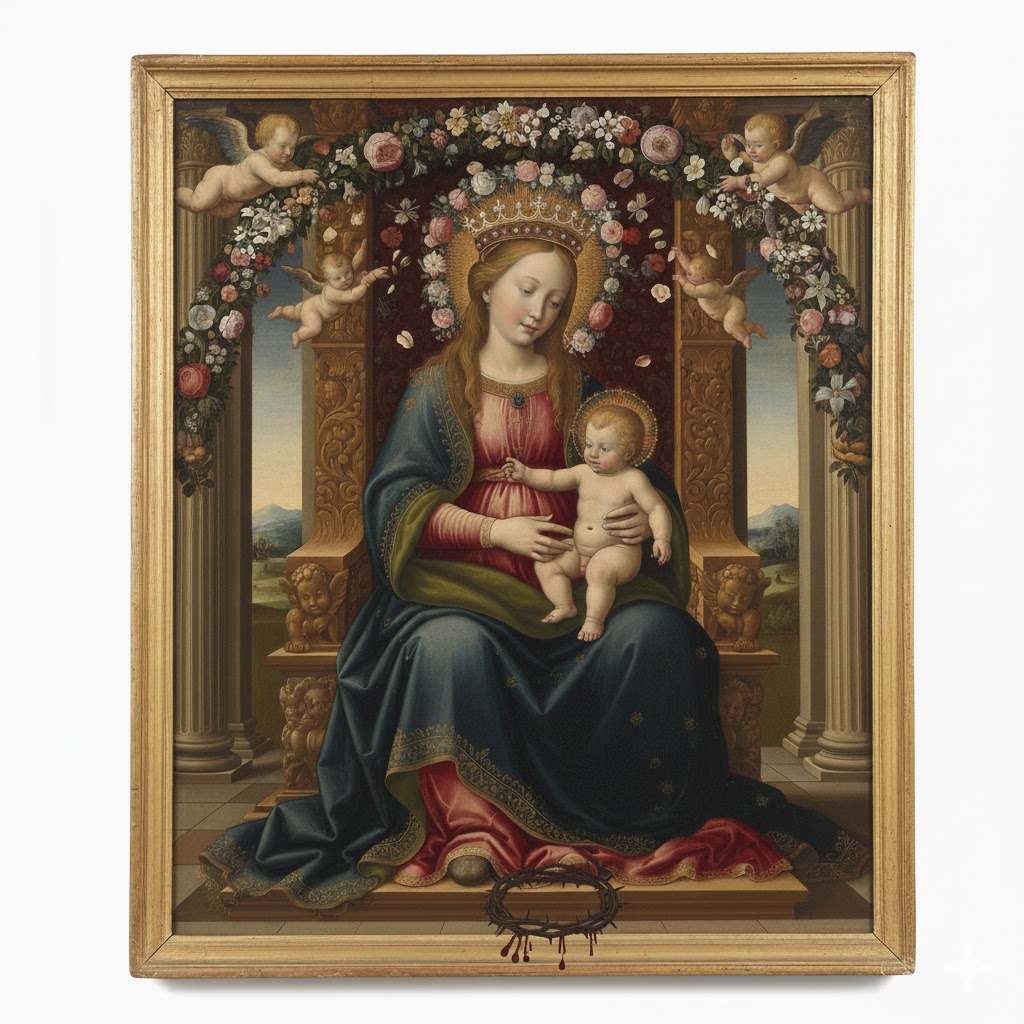
The first title granted to the Virgin Mary by Christians was „Mother of God” (Theotokos). This is how she is celebrated every year on January 1st in the Catholic Church.
The Gospel speaks of the episode in which the shepherds go to worship before the Child in the manger and then spread the news of His Birth, full of joy and veneration toward God.
From Ego-drama to Theo-drama
I would like to focus on what the Evangelist Luke says in this text: “But Mary treasured all these words, pondering them in her heart.” What was Mary pondering?
The American Bishop Robert Barron makes a very interesting distinction between “ego-drama” and “theo-drama.” “Ego-drama” is what we choose to be; we forge our own destiny, we are in control, and we are the directors, actors, and screenwriters of our own lives. God is excluded. In “theo-drama,” on the other hand, we have a supporting role, while the direction and the script are signed by God. What we must do is find our role within this “theo-drama.” In other words, in Christian language, to find our mission. This is what Mary did par excellence.
She understood that before God, one must abandon the ego-drama. It all began with those words addressed to the Archangel Gabriel, the famous “Fiat”: “Behold the handmaid of the Lord. Let it be done to me according to your word.” Finding her mission gives Mary wings; her horizon expands, she acquires meaning and purpose, and she gains spiritual power and depth—a depth so profound that it could contain the Word of God, to whom she gave birth in the form of a Child.
What It Means to Do God’s Will
What would have happened if Mary had refused this mission out of fear of being judged or marginalized? She would have remained a woman with a narrow horizon, of whom no one would have ever heard. By doing the Lord’s will, however, Mary changed the course of history. Thus, following her example, it would be beautiful if we could acquire an unshakable trust that God has plans for us that are infinitely better than the plans we have for our own lives.
This does not mean that doing God’s will implies walking serenely through a field of flowers. However, knowing that you are not alone in the spiritual struggle and that God does not allow evil to destroy you, but to bring an even greater good out of it, uplifts your soul beyond any „misery.”
As for me, I try to view life’s trials as a „Furnace of the Spirit.” As much as illness, weakness, or failure pull me down, to the extent that I put my trust in God, they become a springboard that flings me into His arms.
Writing now, I think of nothing else but doing His will and being a witness to His infinite mercy and love. Bishop Barron also said: “Your life is not about you.” To some, it seems ridiculous. To others, terrifying. To others, it’s a matter of indifference. But those who have „tasted” the feeling of abandoning themselves into God’s hands know how wonderful it is to behold the free movements of the soul.
And while suffering crushes many, surrendering into God’s hands transforms your suffering into a „cell”—a monk’s chamber—where the soul is refined by fire; a fire that does not burn, but transforms this „cell” into a place of light, a place of encounter with Christ.
Mary – Our Guide in Finding Our Mission
What was Mary pondering in her heart? Surely, she pondered her mission and, above all, the mission of the Incarnate Word. Doing God’s will does not mean you always know where you are headed. Many times you are uncertain, you feel lost, you have the impression that God has forgotten you; but as Caryl Houselander said: “God’s silence is, in fact, an embrace so tight that there is no longer any room for words”
Mary sacrificed herself for the Incarnate Word and, at the same time, for each of us. And she continues to sacrifice her „time” in eternity to help us find our mission just as she found hers: through deep prayer in a soul full of peace and trust in God’s will.
Have you thought about which drama you are playing in: ego-drama or theo-drama?
 Fereastra spre sens
Lasă un comentariu